

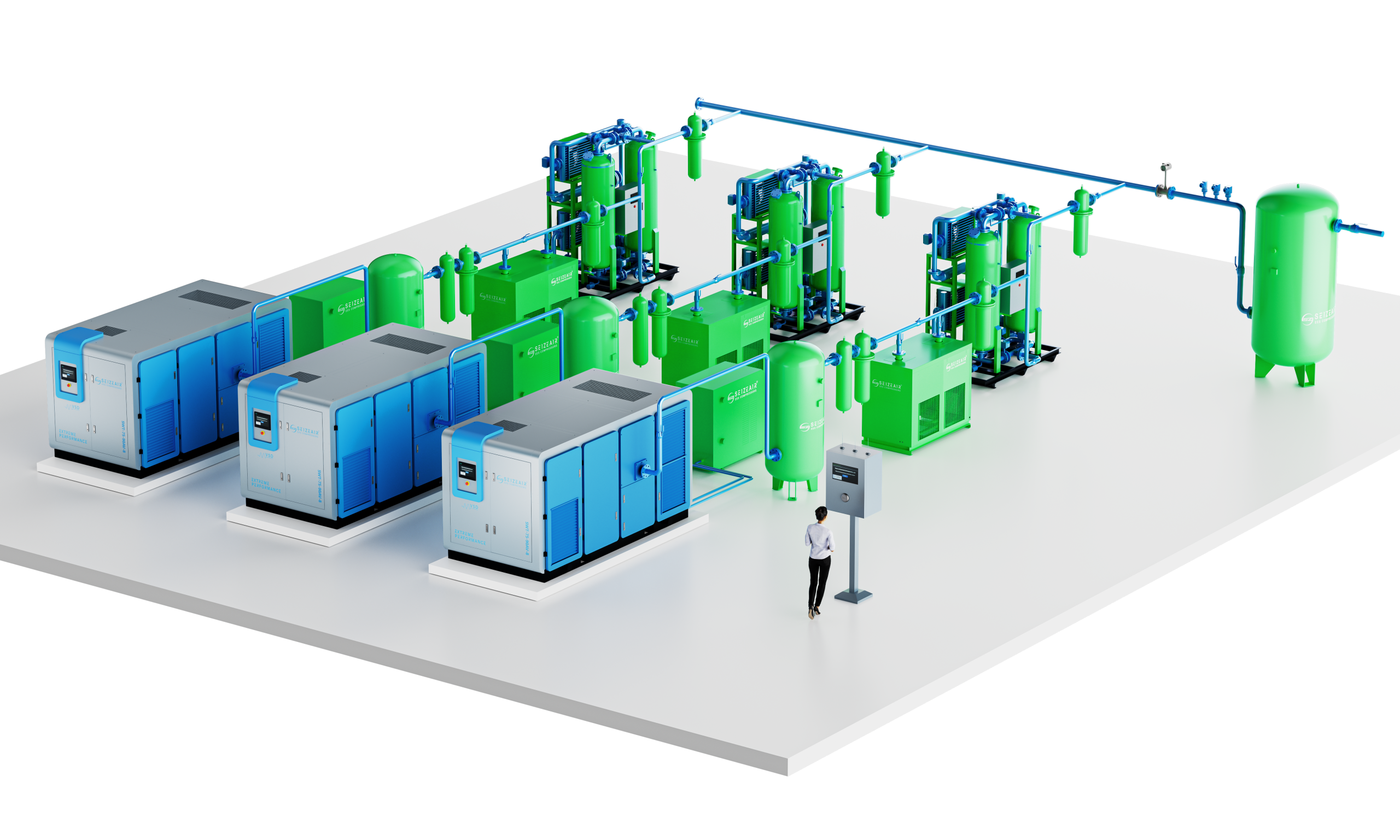
The European industrial compressed air market is entering a defining two-year period. Four structural forces—smart factory digitization, tightening carbon regulations, manufacturing reshoring, and a technology arms race between oil-free screw and magnetic levitation centrifugal compressors—are converging simultaneously. For plant managers, procurement officers, and engineering directors across the EU, the decisions made in 2025-2026 will determine energy cost trajectories, regulatory compliance, and production reliability for the next decade.
Compressed air accounts for approximately 10% of industrial electricity consumption in Europe, according to the European Commission’s energy efficiency directives. With electricity prices in Germany averaging €0.18-0.25/kWh for industrial users in 2025 and EU Emissions Trading System (EU ETS) carbon prices hovering above €80 per tonne, the financial stakes of compressor selection have never been higher.
This article maps the four trends reshaping the European air compressor landscape and explains what they mean for your facility’s next investment cycle.
1. Industry 4.0 Arrives at the Compressor Station
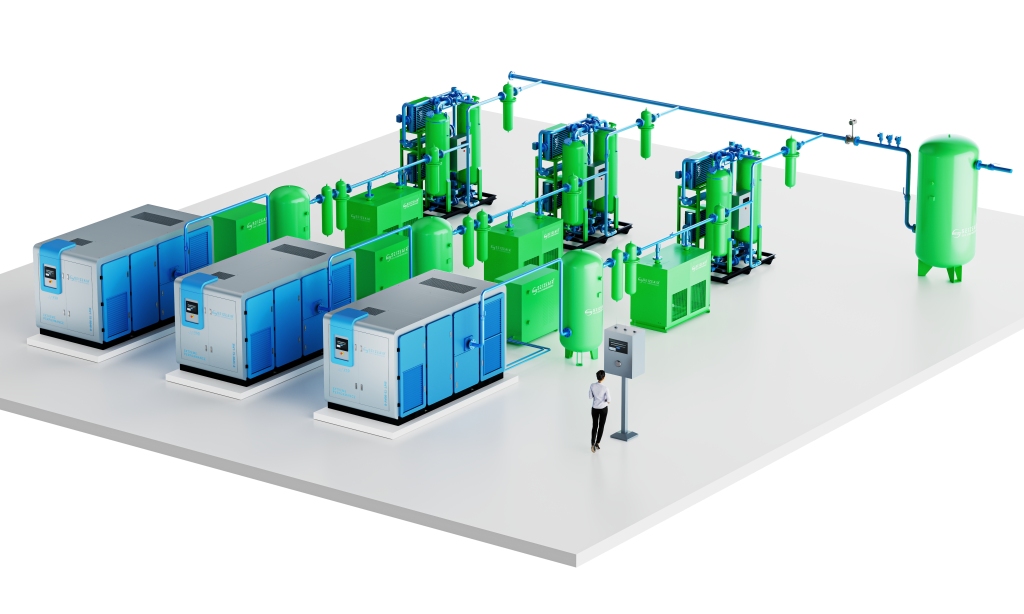
The compressor room—long the forgotten corner of the factory floor—is becoming the nerve center of Industry 4.0 deployments. Three technological shifts are driving this transformation.
Predictive Maintenance and Digital Twins
Unscheduled compressor downtime in a continuous-process plant can cost €5,000-50,000 per hour in lost production. Traditional reactive maintenance models, where compressors run to failure, are being replaced by predictive maintenance platforms that combine vibration analysis, oil quality spectroscopy (for oil-injected units), temperature trend monitoring, and motor current signature analysis.
The 2025 state of the art moves beyond simple threshold alerts. Leading platforms now deploy digital twins—real-time virtual replicas of the physical compressor installation—that simulate wear progression under actual load profiles. A German automotive supplier reported in 2024 that digital twin deployment across its 14-compressor station reduced unplanned downtime by 72% and extended air-end service intervals from 24,000 to 32,000 operating hours.
IoT-Enabled Remote Monitoring and Centralized Control
Multi-compressor stations with mixed-vintage equipment are the norm in European manufacturing, not the exception. IoT retrofit kits—vibration sensors, pressure transducers, dew-point monitors, and flow meters—can now bring a 15-year-old compressor onto the same monitoring platform as a brand-new variable-speed unit.
The operational payoff is substantial. A centralized controller with real-time pressure/flow data can sequence compressors to minimize part-load operation and trim the pressure band by 0.3-0.5 bar. Each 0.1 bar reduction in system pressure saves approximately 0.8% in specific power consumption (kW/m³/min). Over a 8,000-hour operating year on a 250 kW installation, a 0.3 bar trim translates to roughly €4,300 in annual electricity savings at €0.18/kWh.
Data-Driven Energy Management
The EU Energy Efficiency Directive (EED) recast, effective from 2024, requires large enterprises to implement energy management systems with auditable KPIs. For compressed air, this means moving from a single utility-meter reading to granular monitoring: specific power (kW per m³/min), leakage rate as a percentage of total output, pressure drop across filtration and drying stages, and per-shift consumption profiles.
SEIZE AIR offers IoT-ready compressor packages with integrated energy monitoring that map directly to ISO 50001 audit requirements, giving European plant managers the data granularity needed for EED compliance without third-party retrofits.
2. Carbon Neutrality Reshapes Compressed Air Economics
The EU Green Deal’s “Fit for 55” package and the Carbon Border Adjustment Mechanism (CBAM) are not distant policy abstractions—they are reshaping compressor specifications right now.
Regulatory Pressure Points
Three regulations directly impact compressed air system design and operation:
- EU Taxonomy Regulation: Classifies economic activities as environmentally sustainable. Manufacturing facilities seeking green financing must demonstrate that compressed air systems meet best-available-technology energy efficiency thresholds. Oil-free compressor technology, with its inherent advantage in energy efficiency at higher pressures, increasingly features in Taxonomy-aligned investment proposals.
- CBAM Phase-In (2023-2026): The transitional phase requires importers of cement, iron/steel, aluminum, fertilizers, electricity, and hydrogen to report embedded emissions. Full financial obligations begin January 2026. For European manufacturers in CBAM-covered sectors, every kilowatt-hour saved in compressed air directly reduces the carbon cost embedded in their products—creating a hard financial incentive for high-efficiency compressor upgrades.
- EU ETS Reforms: Free allowances are phasing out for aviation (2026) and declining for industrial sectors. The Market Stability Reserve continues absorbing surplus allowances, keeping carbon prices structurally elevated. A facility running oil-injected screw compressors at 7.5 kW/m³/min specific power that upgrades to oil-free technology achieving 6.2 kW/m³/min saves not only electricity cost but also the embedded carbon cost on CBAM-affected output.
Heat Recovery: The Low-Hanging Fruit
An air compressor converts roughly 85-94% of its electrical input into heat. In traditional installations, this heat is rejected to atmosphere through cooling systems—a pure loss. Heat recovery systems can capture 70-80% of this thermal energy for space heating, process water preheating, or boiler feedwater.
A 200 kW compressor operating 6,000 hours annually rejects approximately 1,020 MWh of thermal energy. Recovering 75% of that displaces roughly 76,500 m³ of natural gas (at 90% boiler efficiency), saving approximately €30,000-45,000 per year at current European gas prices. The EU Energy Efficiency Directive explicitly encourages industrial heat recovery, and several member states (Germany, Austria, Netherlands) offer investment subsidies covering 20-40% of heat recovery system installation costs.
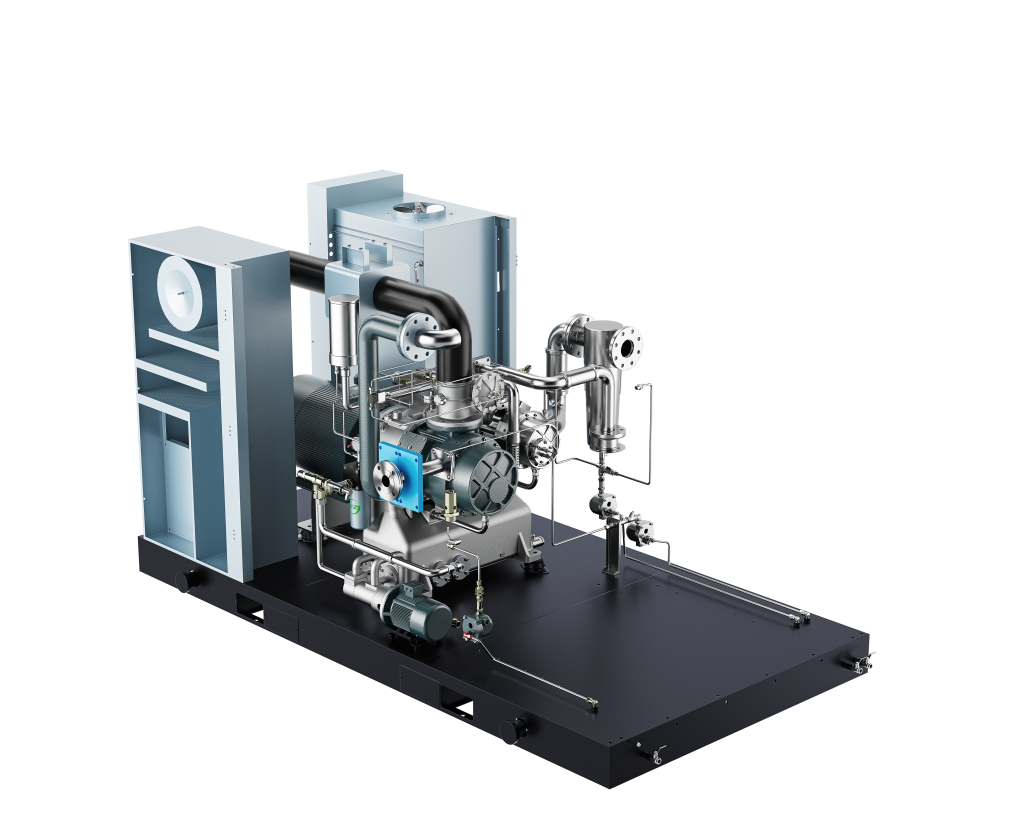
The Total Carbon Ownership Lens
Forward-looking procurement teams are moving from simple payback-period analysis to Total Carbon Ownership (TCO₂) modeling. This framework calculates the full lifecycle carbon cost of a compressor: manufacturing emissions, operational electricity emissions over 15 years (using forward carbon price curves), refrigerant leakage (GWP impact), and end-of-life recycling value.
Under TCO₂ analysis, an oil-free screw compressor—with zero oil separator waste, longer service intervals requiring fewer consumable parts, and no oil-contaminated condensate treatment—often shows a 15-25% lifecycle carbon advantage over oil-injected equivalents of the same power class. This advantage becomes directly monetizable as CBAM obligations take full effect and internal carbon pricing spreads across European corporate groups.
3. Manufacturing Reshoring: New Demand for Premium Air
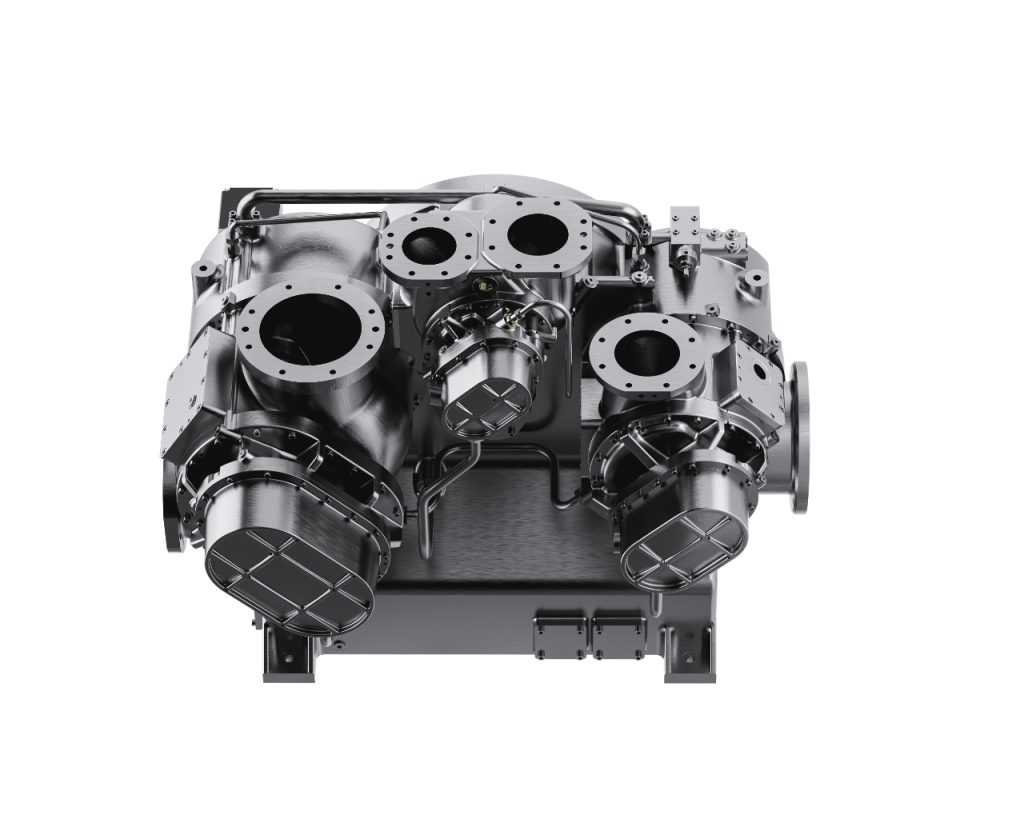
The European Chips Act, the Critical Raw Materials Act, and national-level industrial policies in Germany, France, and Italy are catalyzing a wave of manufacturing investment not seen in decades. Each new facility brings significant compressed air demand—and nearly all of it is oil-free by specification.
Semiconductor Fabs: The TSMC, Intel, and Infineon Effect
TSMC’s Dresden fab (ESMC, 70% stake), Intel’s Magdeburg complex (€30 billion investment), and Infineon’s Villach and Dresden expansions collectively represent over €50 billion in new European semiconductor capacity. Semiconductor manufacturing requires Class 0 oil-free compressed air at multiple pressure levels—typically 7-10 bar for general plant air and 3-5 bar for cleanroom pneumatics—with total installed capacity often exceeding 20 MW per fab.
A single advanced logic fab consumes 40,000-80,000 Nm³/h of compressed air. The TSMC Dresden facility alone is expected to require 60-80 MW of compressor capacity across its compressed air, nitrogen generation, and process vacuum systems. This demand signal is pulling through the entire supply chain: specialty gas suppliers, wafer handling equipment manufacturers, and ultrapure water system providers all require oil-free compressed air.
Battery Gigafactories: Dry Room Demands
European battery production capacity is projected to reach 900-1,200 GWh by 2030, driven by Northvolt (Sweden/Germany), ACC (France/Germany/Italy), PowerCo (Germany/Spain), and CATL’s Hungarian plant. Battery electrode manufacturing—particularly the drying and calendaring stages—requires massive volumes of oil-free compressed air at controlled dew points below -40°C.
Electrode drying alone can consume 30-50% of a gigafactory’s total energy budget, with compressed air systems accounting for a significant share. The shift toward dry electrode coating technology (pioneered by Tesla and being adopted by European manufacturers) changes the compressed air profile but does not reduce total demand—dry processes require high-flow, precisely conditioned air for material handling and dust control.
Pharma and Food & Beverage: Steady Compliance-Driven Demand
The pharmaceutical sector—concentrated in Switzerland, Ireland, Germany, and Belgium—is a consistent driver of oil-free compressed air demand. EU GMP Annex 1 (revised 2023, effective August 2024) tightened requirements for cleanroom operations, including compressed air quality in aseptic manufacturing. Food & beverage processors under BRCGS and IFS standards face similar Class 0 air requirements for direct-contact applications.
These sectors do not drive headline investment figures like semiconductors, but they provide stable, high-margin demand for oil-free compressor systems with full documentation packages and EU regulatory compliance pedigrees. SEIZE AIR positions its oil-free product portfolio to serve both the high-volume semiconductor/battery demand and the compliance-intensive pharma/food sectors with a single platform architecture.
4. Technology Competition: Oil-Free Screw vs. Magnetic Levitation Centrifugal
The most consequential technical debate in compressed air today is not “oil-injected vs. oil-free”—that battle is largely decided for new greenfield installations, which overwhelmingly specify oil-free. The real contest is between oil-free screw compressors and magnetic levitation (maglev) centrifugal compressors.
The Contenders
| Technology | Typical Power Range | Specific Power at 7 bar | Compression Stages | Maintenance Profile |
|---|---|---|---|---|
| Oil-Injected Screw | 7.5-500 kW | 6.8-7.8 kW/m³/min | Single or two-stage | Quarterly oil/filter; annual separator |
| Oil-Free Dry Screw | 37-560 kW | 5.8-6.8 kW/m³/min | Two or three-stage | Annual air-end inspection; no oil handling |
| Maglev Centrifugal | 75-750 kW | 5.3-6.2 kW/m³/min | Single or two-stage | Magnetic bearing zero-wear; annual capacitor check |
| Oil-Free Scroll | 2.2-45 kW | 7.0-8.5 kW/m³/min | Single-stage | Scroll element replacement at 40,000 hrs |
Sources: Manufacturer datasheets (Atlas Copco, Ingersoll Rand, SEIZE AIR, Danfoss Turbocor), compressed air industry benchmarks, 2025.
Where Each Technology Wins
Oil-injected screw remains cost-effective for applications where air quality requirements permit trace oil carryover: general manufacturing, construction, metal fabrication, and tire inflation. The installed base in Europe exceeds 500,000 units. However, rising electricity prices and CBAM carbon costs are narrowing the total-cost-of-ownership gap against oil-free alternatives for high-utilization installations.
Oil-free dry screw is the workhorse for medium-to-large industrial applications requiring Class 0 air: food processing, pharmaceutical manufacturing, electronics assembly, and chemical processing. Three-stage designs (such as SEIZE AIR’s SWT Series) achieve specific power values competitive with centrifugal compressors in the 75-250 kW range while maintaining the wide turndown capability (typically 30-100%) that centrifugal machines cannot match without hot-gas bypass. The SWT Series’ three-stage compression with intercooling and advanced rotor profiles reduces specific power to approximately 5.9-6.3 kW/m³/min at 7 bar—within 5-8% of maglev centrifugal performance at significantly lower capital cost.
Maglev centrifugal excels in high-flow, base-load applications above 250 kW where the load profile is stable and turndown requirements are modest. The zero-contact magnetic bearing eliminates lubricant entirely and enables oil-free operation with bearing life theoretically exceeding 30 years. Danfoss Turbocor and Hanbell dominate this segment. However, maglev centrifugal compressors carry a 40-80% capital cost premium over oil-free screw, and their narrow efficient operating window (typically 70-100% load) requires careful system design to avoid inefficient part-load operation during shift changes or seasonal demand fluctuations.
SEIZE AIR SWT Series: The Sweet Spot
The SEIZE AIR SWT Series two-stage and three-stage oil-free screw compressors target the 45-315 kW power band that covers approximately 70% of European industrial compressed air demand by installed capacity. The three-stage configuration, with its intercooled rotor stages and proprietary airend profile, bridges the efficiency gap between traditional two-stage oil-free screw and maglev centrifugal while preserving the flexibility advantages of positive-displacement compression.
Key differentiators include:
- Three-stage compression with intercooling: Reduces the compression ratio per stage, minimizing thermal losses and improving isentropic efficiency by 8-12% over two-stage designs
- Variable-speed drive integration: Allows efficient operation from 25-100% of rated flow, critical for multi-shift European manufacturing with significant demand variation
- Heat recovery-ready design: Integrated heat exchanger connections simplify the addition of heat recovery systems, supporting the EU EED compliance pathway
- IoT-native control platform: Built-in connectivity aligns with Industry 4.0 requirements out of the box—no retrofit needed
For the plant manager evaluating a 160 kW compressor for a food processing line, the SWT Series delivers specific power within 6-8% of a maglev centrifugal at roughly 55-65% of the capital investment, with shorter lead times and simpler installation requirements. For the semiconductor fab engineer specifying a 10-unit station with 30 MW total capacity, the turndown flexibility of screw technology across multiple parallel units provides better overall system efficiency than a smaller number of large centrifugal base-load machines.
Total Cost of Ownership: A 10-Year View
Consider a 200 kW compressor operating 7,500 hours/year at €0.20/kWh, with a 2% annual electricity price escalator and €85/tonne CO₂ price rising at 5% annually:
| Cost Component | Oil-Injected Screw | Oil-Free 2-Stage Screw | Oil-Free 3-Stage Screw | Maglev Centrifugal |
|---|---|---|---|---|
| Capital (installed) | €52,000 | €98,000 | €125,000 | €205,000 |
| 10-year electricity | €1,740,000 | €1,545,000 | €1,425,000 | €1,338,000 |
| 10-year maintenance | €145,000 | €68,000 | €62,000 | €48,000 |
| 10-year carbon cost | €78,000 | €69,000 | €64,000 | €60,000 |
| Total 10-year TCO | €2,015,000 | €1,780,000 | €1,676,000 | €1,651,000 |
The analysis shows that oil-free three-stage screw and maglev centrifugal converge within 1.5% of each other on a 10-year TCO basis. For most European industrial applications in the 75-315 kW range, the oil-free three-stage screw offers the optimal balance of capital efficiency, energy performance, and operational flexibility.
Conclusion: Four Forces, One Decision Framework
The European industrial air compressor market in 2025-2026 does not reward those who optimize for a single variable. The facility that buys the cheapest compressor but ignores IoT connectivity will fail EED audits. The plant that specifies oil-free but skips heat recovery will leave €30,000-45,000 per year on the table. The company that matches CBAM-exposed production with an oil-injected legacy compressor will pay twice—once in electricity and once in carbon.
The decision framework for your next compressor investment should weigh five factors simultaneously:
- Energy efficiency at your actual load profile (not just full-load nameplate data)
- Carbon cost trajectory under EU ETS and CBAM through 2030
- IoT/Industry 4.0 readiness for EED and ISO 50001 compliance
- Technology fit for your application’s air quality requirement (Class 0 or not)
- 10-year TCO including electricity, carbon, maintenance, and capital amortization
The SEIZE AIR product portfolio addresses this framework directly: oil-free screw technology spanning 45-315 kW with three-stage efficiency, heat recovery integration, and native IoT connectivity—engineered for European regulatory realities from the ground up.

发表回复