

Compressed air is often called the “fourth utility” in European manufacturing — after electricity, gas and water. It powers production lines, packaging machines, pneumatic tools, paint booths and countless automated processes. Yet unlike the other three utilities, compressed air is generated on site, and much of the energy that goes into it is quietly wasted. Industry studies consistently show that compressed air systems consume between 8 and 12 percent of all industrial electricity in the European Union, and that up to 50 percent of that energy can be recovered through better equipment selection, smarter controls and disciplined maintenance.
For European plant managers, energy managers and procurement teams, the equation has changed. It is no longer enough to buy “a compressor.” New EU ecodesign rules are tightening the efficiency bar, electricity prices remain structurally higher than in most regions, and sustainability reporting now puts energy data on the boardroom table. This article explains how European buyers can turn compressed air from a cost centre into a measurable return on investment — and why the decisions made in 2026 will determine energy bills for the next decade.
1. Why Compressed Air Is Still the Biggest Hidden Energy Cost in European Factories
Before discussing solutions, it helps to understand the scale of the problem. A typical industrial compressed air installation runs for thousands of hours per year. Over a ten-year lifetime, the electricity consumed by a compressor accounts for roughly 75 to 80 percent of its total cost of ownership. The purchase price is a minor footnote.
Consider a mid-sized plant with three 55 kW compressors operating 6,000 hours per year at an average load of 70 percent. Annual electricity consumption can easily reach 600,000 to 700,000 kWh. At a typical European industrial electricity price of 0.15 to 0.20 EUR per kWh, that is EUR 90,000 to 140,000 per year on compressed air alone — and a 15 percent efficiency improvement is worth EUR 15,000 to 20,000 saved every single year.
Three factors amplify this problem in Europe specifically:
- High and volatile electricity prices. European industrial electricity prices remain among the highest in the world. Energy efficiency is not a “green nice-to-have”; it is a direct line item on the P&L.
- Tightening regulation. The EU is phasing in stricter efficiency requirements for new air compressors, with a major tightening step in July 2025 and a further step in July 2027. Equipment sold today must be judged against tomorrow’s limits.
- Corporate sustainability reporting. Under the Corporate Sustainability Reporting Directive (CSRD), large companies — and increasingly their suppliers — must disclose energy consumption and decarbonisation plans. Compressed air is one of the easiest places to demonstrate real, auditable savings.
The good news: compressed air efficiency is one of the most mature, well-documented engineering disciplines in industry. The tools to fix it — better compressors, variable speed drives, heat recovery, leak management, modern controls — have been proven for decades. The gap is not technology; it is decision-making.
2. The EU Regulatory Landscape: What Compliance Actually Means in 2026
Many European buyers assume “CE marked” is the only legal checkbox. The reality is more specific — and more demanding.
2.1 Ecodesign: Regulation (EU) 2021/1705
The key legislation for air compressors is Commission Regulation (EU) 2021/1705, adopted under the Ecodesign Directive (2009/125/EC). It applies to electric motor-driven air compressors with a rated power input between 0.75 kW and 1,500 kW — in practice, the vast majority of industrial equipment sold in Europe.
The regulation introduces a metric called Specific Energy Requirement (SER), which measures the energy consumed per unit of compressed air output (kW per m³/min). Compliance is assessed against a standardised “Hydraulic Installation” (HI) profile that reflects realistic part-load operation, not just a full-load nameplate number.
The timeline matters:
- Stage 1 requirements have applied since October 2021.
- Stage 2 — a significantly tighter threshold — has applied to new products placed on the market since 1 July 2025.
- Stage 3, the strictest tier, follows on 1 July 2027.
In practice, Stage 2 has reshaped the market. To meet the tighter SER limits across a range of duty profiles, manufacturers have shifted from IE3 induction motors to IE4/IE5 permanent magnet (PM) motors, and from fixed-speed designs to variable speed drive (VSD) technology. For many power ranges, a fixed-speed compressor is no longer a credible route to compliance. European buyers should treat VSD as the baseline, not a premium option.
2.2 What the Regulation Does — and Does Not — Do
Regulation (EU) 2021/1705 restricts the placing on the market of new, non-compliant compressors. It does not force anyone to scrap existing machines. However:
- Under the Energy Efficiency Directive (EED), large enterprises must conduct energy audits every four years. An inefficient legacy compressor is exactly the kind of finding that auditors flag — and expect a response to.
- Under ISO 50001 energy management systems, continuous improvement is a requirement. A plant that ignores a 20 percent saving opportunity is, in audit terms, leaving money on the table.
- Buyers must verify the EU Declaration of Conformity references Regulation (EU) 2021/1705 and carries the SER data. Beware of very cheap imports that claim exemptions without documentation.
2.3 Air Quality and Refrigerant Rules
Compliance is not only about energy. European food, beverage, pharmaceutical and electronics producers must also meet ISO 8573-1 air quality classes for particles, water and oil — which is why oil-free screw compressors for Class 0 or Class 1 applications are part of the compliance story. In addition, refrigerant dryers fall under the EU F-Gas Regulation: the phase-down of high-GWP refrigerants affects dryers and chillers, so buyers should ask for the GWP value of the refrigerant in every drying package.
3. The ROI of Efficiency: How to Build a Business Case That Survives the Boardroom
Energy savings are only compelling if they can be quantified. European capex requests are scrutinised; “it is more efficient” is not a business case.
3.1 Measure First
You cannot manage what you do not measure. Before replacing anything, establish a baseline with flow meters, power meters and pressure transducers. For one week, capture total kWh consumed by the compressor room, actual air flow and demand profile, system pressure, and leak load during off-production hours.
3.2 The Standard Savings Stack
For a typical European plant, well-documented measures deliver the following:
| Measure | Typical Energy Saving | Typical Payback |
|---|---|---|
| Fixing air leaks (15–30% of demand) | 10–30% of total demand | 3–12 months |
| Right-sizing the compressor to actual demand | 10–25% | 6–18 months |
| Replacing fixed-speed with VSD for variable load | 20–35% on that unit | 1.5–3 years |
| Installing master controls (sequencing) | 5–15% on multi-unit systems | 1–2.5 years |
| Heat recovery for space heating or process water | Recovers up to 90% of input energy | 1–3 years |
| Reducing system pressure by 1 bar | ~7% energy per bar saved | Immediate |
Take leaks. A typical industrial system loses 20 to 30 percent of its compressed air through leaks. Leaks are not just wasted energy; they depress system pressure, forcing the compressor to run longer or at higher pressure. A structured leak detection and repair programme is usually the fastest, cheapest win in the plant — and it makes every downstream investment smaller.
3.3 Building the ROI Number
Here is a worked example. A plant replaces a 55 kW fixed-speed compressor with a modern 55 kW permanent magnet VSD unit and simultaneously fixes a 20 percent leak load.
- Annual baseline electricity: ~350,000 kWh for this unit at 6,000 hours/year.
- Saving from VSD on a variable load profile: ~25 percent = 87,500 kWh.
- Saving from leak reduction: ~15 percent of remaining demand ≈ 39,000 kWh.
- Combined saving: ~126,500 kWh per year ≈ EUR 22,770 per year at 0.18 EUR/kWh.
With a package price of EUR 45,000 to 60,000 installed, the payback lands in the 2–2.5 year range — comfortably inside most European capex rules and extremely attractive against a 10-year equipment life. Add heat recovery, and the payback can drop below two years.
3.4 Counting the Non-Energy Benefits
The ROI story does not end with kWh. New-generation compressors bring higher reliability (unplanned stops can cost tens of thousands of euros per hour in food or pharmaceutical plants), better air quality, quieter operation, and data-ready controls that support condition monitoring and the energy reporting demanded by CSRD and ISO 50001. When these are included, the payback is usually far shorter than the energy-only calculation suggests.
4. Choosing the Right Technology: Screw, VSD, Oil-Free and Complete Stations
Europe is a mature market with a wide range of compressor technologies. The right choice depends on duty profile, air quality needs, ambient conditions and future expansion plans.
4.1 Rotary Screw Compressors — The Workhorse
Rotary screw compressors remain the default for most European industrial applications from roughly 5.5 kW upward. They combine compact footprint, continuous duty capability and excellent efficiency. Two sub-categories matter:
- Fixed speed: simple and lowest in first cost, best suited to constant, high-utilisation demand. In the post-2025 regulatory environment, fixed-speed remains viable mainly for smaller sizes and steady base loads.
- Variable speed (VSD): the motor speed tracks demand. For plants with two-shift operation, seasonal demand or fluctuating production, VSD typically cuts energy use by 20 to 35 percent compared with a fixed-speed unit idling through part-load hours.
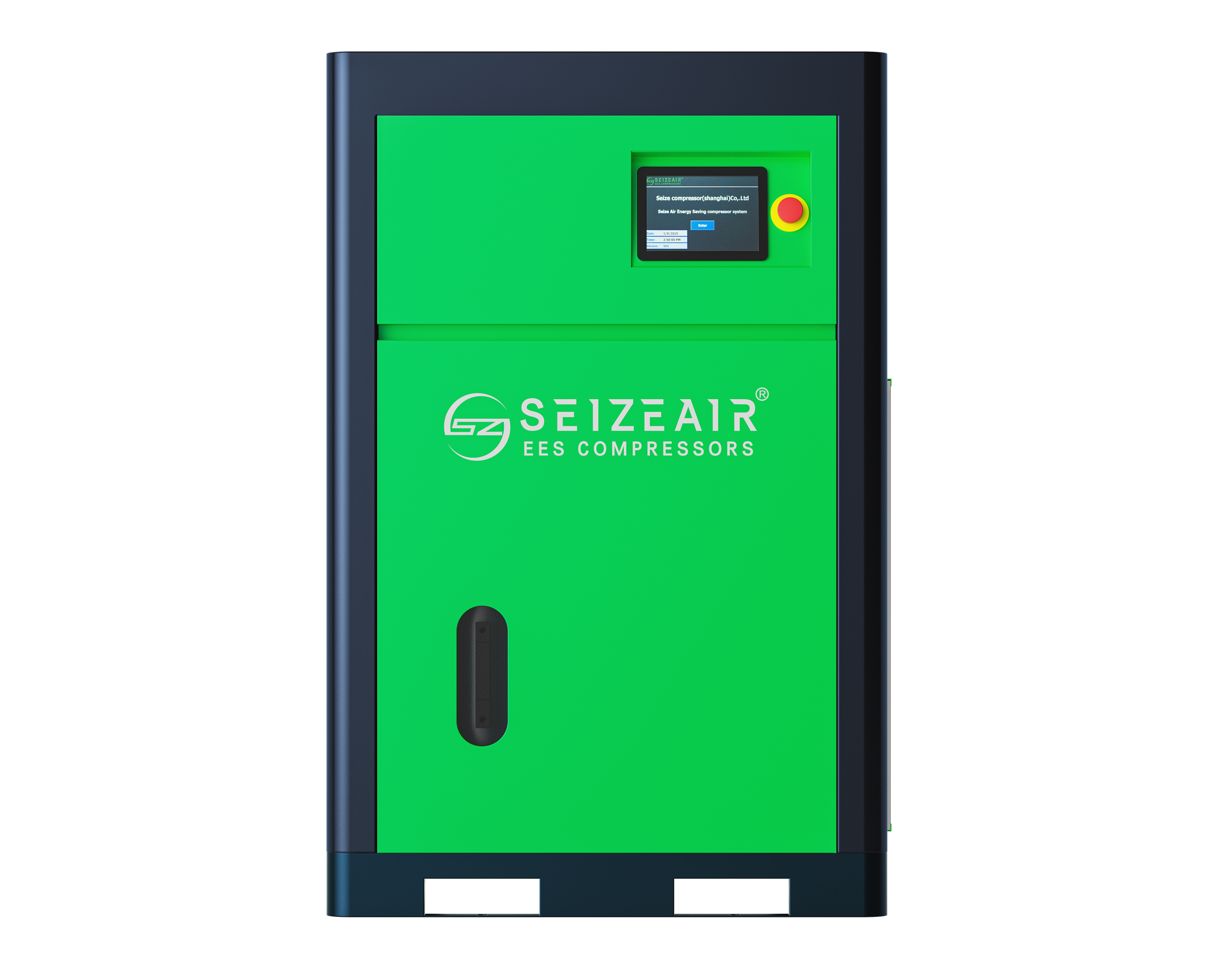
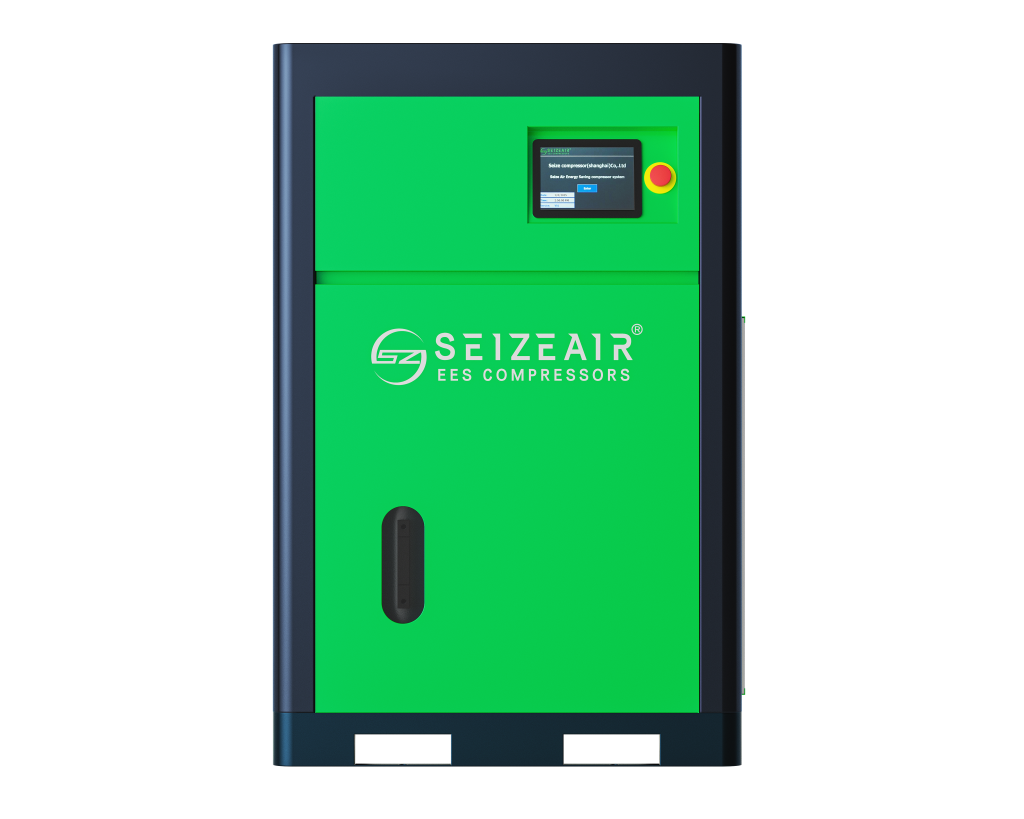
Modern permanent magnet (PM) VSD designs — such as SEIZE AIR’s PM series — combine IE5-class motors with integrated drives to hit the EU’s tighter SER targets while shrinking the physical footprint.
4.2 Oil-Free Screw Compressors — When Air Quality Is Non-Negotiable
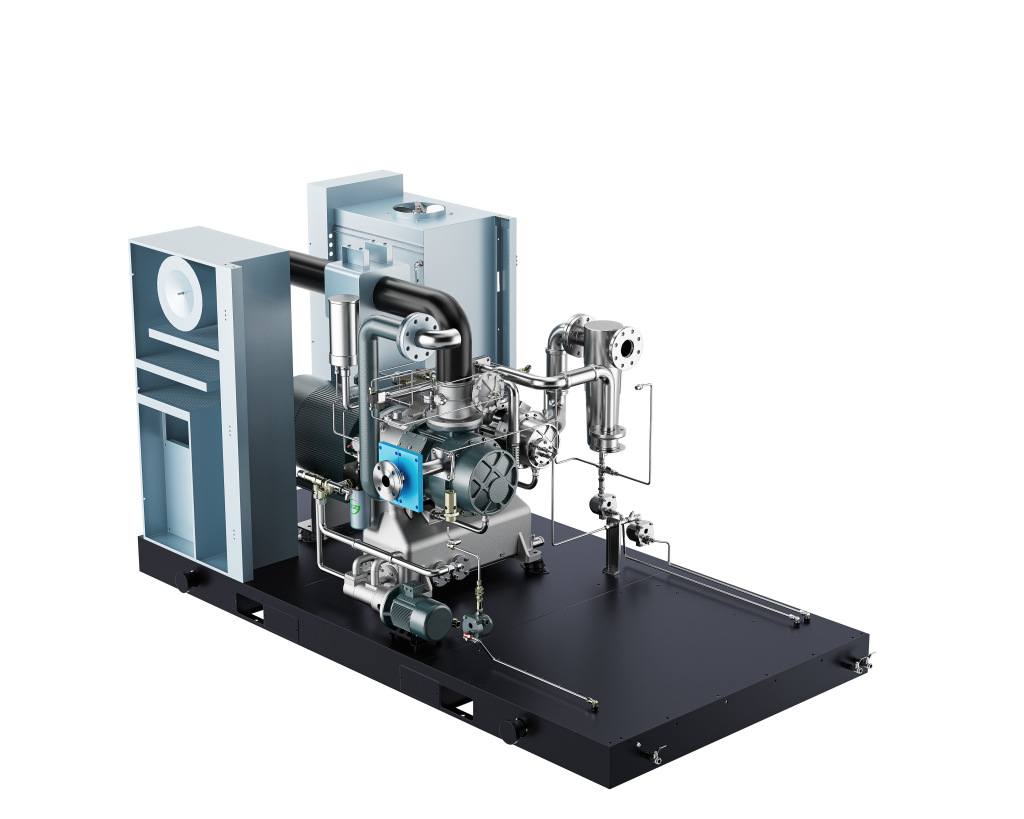
For food, beverage, pharmaceutical, electronics, textiles and chemical applications, ISO 8573-1 Class 0 or Class 1 oil-free air is a hard requirement. Oil-free screw compressors eliminate the risk of lubricant carry-over into the product stream, simplify filtration and reduce maintenance on downstream equipment. Modern two-stage oil-free screw compressors have also closed much of the efficiency gap with oil-injected machines, making their total lifecycle cost — including lower filtration and maintenance burden — increasingly competitive.
4.3 Complete Air Stations — Stop Buying “A Compressor” and Start Buying “A System”
The biggest mistake in European compressed air procurement is buying a compressor in isolation. A compressor is one component of a system that also includes dryers, filters, condensate management, pipework, storage and controls. A well-designed air station right-sizes every component, sequences multiple units so each runs at its efficiency sweet spot, recovers waste heat, and monitors energy, flow, pressure and maintenance remotely. A complete, engineered station can deliver 15 to 25 percent lower system energy consumption than a room full of independently-run compressors. This is why SEIZE AIR supplies not only individual compressors but integrated air station solutions, engineered for European conditions and compliance requirements.
5. Industrial Trends Shaping the European Compressed Air Market
Four trends are reshaping how European plants buy and run compressed air.
5.1 IIoT and Predictive Maintenance
European manufacturers are connecting compressor rooms to the cloud. Remote monitoring platforms track specific energy, runtime, temperature, pressure and maintenance intervals, alerting operators before failures occur. For multi-site operators, one dashboard now covers every plant — and it feeds directly into the energy data required by sustainability reporting.
5.2 Energy-as-a-Service and Managed Air
More European companies are choosing compressed air as a service — paying per m³ of air delivered rather than owning the asset. The supplier owns, maintains and optimises the system, and is contractually incentivised to keep specific energy low. This model removes capex, transfers technical risk, and aligns the supplier’s profit with the customer’s efficiency.
5.3 Heat Recovery as Standard Practice
Up to 90 percent of the electrical energy input to a compressor is converted to heat. European plants — with long heating seasons and high gas prices — increasingly capture that heat for space heating, boiler feed water or process hot water. A 90 kW compressor can deliver roughly 70 kW of usable heat, worth several thousand euros per year. With the 2027 regulatory push toward “heat recovery ready” systems, this is moving from optional to expected.
5.4 The Decarbonised Factory
The EU’s industrial decarbonisation agenda — including the Carbon Border Adjustment Mechanism (CBAM) and national hydrogen strategies — is pushing plants to electrify processes and decarbonise utilities. Compressed air, being inherently electric, is one of the easier systems to decarbonise: every kWh saved is directly a tonne of CO₂ avoided at the grid level. As industrial electricity increasingly comes from renewables, the efficiency message gets stronger, not weaker.
6. A Practical 90-Day Action Plan for European Plants
If you manage compressed air in a European facility, this sequence works:
- Weeks 1–4 — Baseline. Meter the compressor room: kWh, flow, pressure and overnight leak load. You now have the business case.
- Weeks 4–8 — Quick wins. Fix leaks, lower system pressure to the minimum usable setpoint, and check filters and dryers.
- Weeks 8–12 — Strategic review. Map demand against capacity; identify units that are oversized, idling, or running fixed-speed through variable load. Model the VSD or replacement business case with your real data and tariff.
- Then — Execute. Right-size, upgrade or repackage; install monitoring so the savings are visible and auditable; feed the numbers into ISO 50001 or CSRD reporting.
The pattern is universal: measure, fix the waste, then invest. The plant that does this in 2026 locks in savings for a decade — and is ready for the 2027 regulations before they arrive.
7. Partnering for Compliance and Efficiency: Why SEIZE AIR for European Projects
SEIZE AIR designs and builds rotary screw compressors, oil-free screw compressors and complete air stations for European industrial applications. Our equipment is engineered for the efficiency levels demanded by EU ecodesign regulation, available in fixed-speed, PM variable-speed and oil-free configurations, and backed by complete air treatment and control packages.
- EU-ready efficiency: PM VSD and two-stage designs aligned with the tightening SER requirements;
- Oil-free options: Class 0/Class 1 air for food, pharma and electronics;
- Complete stations: dryers, filtration, storage, controls and heat recovery integrated into one engineered solution;
- Documentation: technical files and efficiency data to support your compliance and energy reporting.
Whether you are replacing a single unit or building a new compressor room, explore our industrial compressor range and contact our team for a system-level consultation. Bought as a system, measured properly and matched to the European efficiency road ahead, compressed air can be one of the best-returning investments your plant makes this decade.

发表回复